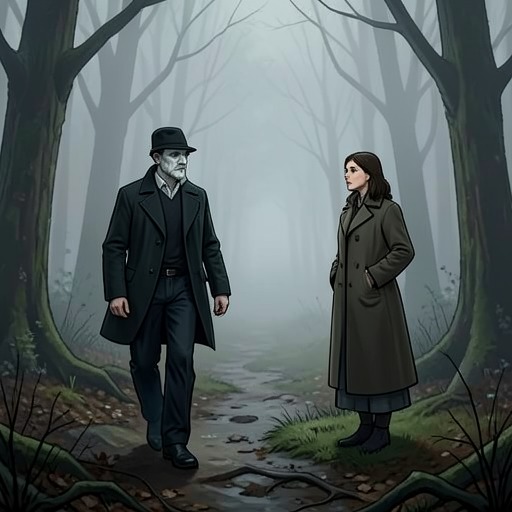
Hat Bowler and Lavinia Maciver’s growing friendship
Good Morning, Midnight (Reginald Hill Edition)Hat Bowler and Lavinia Maciver’s growing friendship begins in a landscape already charged with intimacy and loss, then deepens through small acts of care. Their connection joins Hat’s private grief to Lavinia’s bereavement and illness, but it does not depend on either of them explaining everything: a shared memory, a cup of tea, a garden that needs digging, and a conversation about birds create room for trust to develop.
A shared place and a first milestone
An earlier meeting beneath a beech tree in a surviving patch of Blacklow Forest had become a milestone for Hat and the woman beside him. A deer had leapt from the copse and forced Hat to skid his car to a halt; afterward, the two pushed through a hedge, sat beneath the tree, drank coffee, and talked with a freedom and intimacy they had not reached before. Hat’s recollection describes that encounter as part of a journey that proved far too short, giving the friendship an undertone of lost possibility even before it has fully taken shape.
The tree also becomes a place Hat returns to alone. The previous day, he drove to the same spot and sat there as darkness and mist thickened. When he eventually set off, he missed his way, wandered over rough grass and boggy fields, and fell asleep exhausted beneath another tree. At dawn, waking under branches, he briefly imagined he was still asleep and dreaming. The sequence links his memory of intimacy with a solitary, disoriented passage through grief; the landscape that once held a conversation now holds his isolation.
News of death and the return to Lavinia
Lavinia’s home becomes the setting for a new turn in their relationship. When Laurence Waverley arrives, Hat is present as Lavinia learns that her nephew, Palinurus Maciver Junior, has died by suicide at Moscow House, like her brother before him. After the news, Lavinia sits in silence for almost a minute. She then acknowledges the shock and asks whether she is needed, asking Waverley to advise her. His suggestion that she come with him gives her a practical next step, while Hat notices that the shock has put Waverley and Lavinia on first-name terms and made his own presence feel obtrusive.
Hat’s later approach to Blacklow Cottage is less a response to an obligation than an uncertain attempt to reconnect. He wakes feeling better than he has for many weeks, with a dream of budding fruit trees and nesting birds rather than dark forests. Hungry, he finds nothing tempting in his fridge and drives toward the cottage. Only as he nears his destination does he acknowledge the feelings, needs, and rights of other people—a small but important sign that his attention is beginning to turn outward again.
Hospitality, illness, and a practical offer
When Hat returns, Lavinia welcomes him into the kitchen. Waverley has come to check that she is well and leaves after seeing that she is in good hands. Once he is gone, Lavinia treats Hat as the person remaining with her, and his awkward effort to explain why he came turns into a concrete offer: he noticed that her kitchen garden needed digging over before planting and wondered whether she could use help. He immediately worries that the offer might imply she cannot manage the work herself.
Lavinia answers his embarrassment directly. If they are to be friends, she says, he must stop being embarrassed by her health. Her multiple sclerosis makes caring for the garden harder, but she is particular about who she lets work in it because, as she puts it, she has friends living there. The remark connects her physical limits to a cherished garden populated by birds, while making the offer of help something she can choose to accept rather than a form of pity. Before deciding whether to give him a spade, she asks him to tell her about himself.
Her attention to Hat is both perceptive and restrained. She recognizes that his odd behavior comes from deep personal loss, but says she will not pry into its details. Instead, she notices that he has eaten a great deal of bread and interprets his healthy appetite as evidence that a hurt body or mind is healing. She then asks how he became interested in birds. Her care does not require confession as its price: she makes space for his grief while directing the conversation toward something that still gives him pleasure.
Birds as a language of recognition
Hat traces his interest back to a holiday on the Pembrokeshire coast when he was six. Sitting on a beach beneath a rough sea, he watched two cormorants hurtle just above the waves and tried to imagine what it would feel like to fly at their speed, with the ocean surging below and spray striking their bodies. He remembers the experience as an imaginative attempt to inhabit another creature’s view of the world. As he grew older, his interest widened from imagining what birds felt to learning what they were actually doing, but he never forgot that first imagined flight.
For Hat, flying with the cormorants eventually became an image of life itself. When Lavinia asks whether he managed to imagine the experience, he distinguishes the physical sensation he could picture as a child from what he came to understand later: living, he says, is what it is like. The birds give him a way to describe an existence that includes danger and exhilaration without reducing it to either. Lavinia receives the account without treating it as eccentric or incidental; she says it makes more sense than almost anything she has heard in the last few days. Two blue tits, Impy and Lopside, settle on Hat’s shoulders as she listens, making the birds an immediate presence in the conversation as well as its subject.
The friendship’s emerging shape
The friendship develops through reciprocal recognition rather than a sudden declaration of closeness. Hat notices Lavinia’s garden and offers labor; Lavinia acknowledges the effects of her illness without letting it define the whole encounter. She feeds him, asks about his interests, and respects the boundary around his loss. He, in turn, makes an effort to return to her home and to be useful, even while struggling to express himself without embarrassment.
The relationship remains at an early stage in these scenes, but its terms become clearer: practical help is offered without assuming helplessness, and emotional understanding is offered without forcing disclosure. The earlier conversation beneath the beech tree established an unusual intimacy; after bereavement and Hat’s lonely return to that place, the kitchen at Blacklow Cottage gives the connection a possible everyday form. Birds thread the scenes together—not merely as Lavinia’s garden companions or Hat’s lifelong interest, but as the subject through which he can speak about living and she can show that she understands.